
- Teacher: Niklas Ahlgren
- Teacher: Alexander Back
- Teacher: Niklas Ahlgren
- Teacher: Alexander Back
- Teacher: Niclas Meyer
Kursen erbjuder en modern introduktion till ekonometrin med tyngdpunkten på ekonometriska metoder tillämpade på verkliga ekonomiska problem. Ekonometrin använder statistiska metoder för att undersöka ekonomiska frågeställningar. Ekonometri används på alla områden av empirisk ekonomi för att testa ekonomiska teorier, för ekonomiskt beslutfattande och för att prognosticera ekonomiska variabler. Metoderna som tas upp på kursen är motiverade av de problem som uppkommer vid analys av icke-experimentella ekonomiska data. På kursen behandlas huvudsakligen linjära regressionsmodeller för tvärsnittsdata.
- Teacher: Christian Johansson
Kursen erbjuder en modern introduktion till ekonometrin med tyngdpunkten på ekonometriska metoder tillämpade på verkliga ekonomiska problem. Ekonometrin använder statistiska metoder för att undersöka ekonomiska frågeställningar. Ekonometri används på alla områden av empirisk ekonomi för att testa ekonomiska teorier, för ekonomiskt beslutfattande och för att prognosticera ekonomiska variabler. Metoderna som tas upp på kursen är motiverade av de problem som uppkommer vid analys av icke-experimentella ekonomiska data. På kursen behandlas huvudsakligen linjära regressionsmodeller för tvärsnittsdata.
- Teacher: Christian Johansson
- Teacher: Niclas Meyer
The course is given both in English and Swedish in Helsinki.
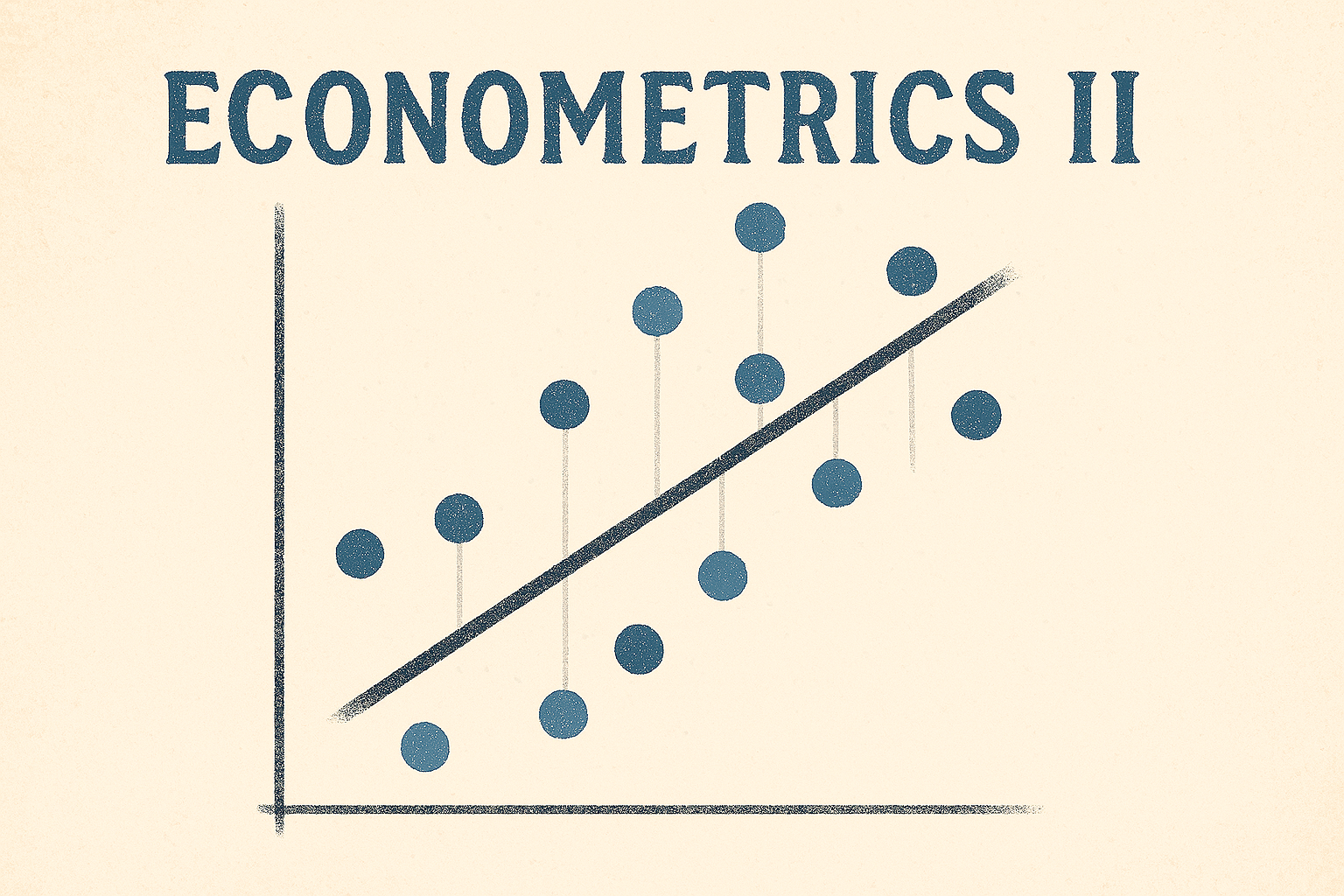
The course offers a modern introduction to econometrics, focusing on real-life economic problems. Econometrics employs statistical methods to answer economic questions and is utilized in all fields of applied economics for testing economic theories, informing policymakers and predicting economic variables. Because of the nonexperimental nature of most data, uncovering causal relationships may be challenging. The main topic of the course is linear regression models for cross-sectional data.
The course offers a modern introduction to econometrics, focusing on real-life economic problems. Econometrics employs statistical methods to answer economic questions and is utilized in all fields of applied economics for testing economic theories, informing policymakers and predicting economic variables. Because of the nonexperimental nature of most data, uncovering causal relationships may be challenging. The main topic of the course is linear regression models for cross-sectional data.
- Teacher: Christian Johansson
- Teacher: Niclas Meyer

The course is intended as an introduction to time series models in econometrics. The first part of the course considers stationary linear time series model. The second part deals with multivariate time series models, unit roots, cointegration and volatility models. Empirical examples are mainly from Finance.
The course is intended for master's students in finance and economics with an interest in statistics and econometrics. The course can also be taken by doctoral students.
After completing the course, you will be able to:
Solve linear difference equations
Apply basic concepts from stochastic processes like stationarity and the autocovariance function to analyse time series
Analyse stationary linear time series models, fit the models to data and perform inference
Analyse non-stationary and cointegrated time series models, fit the models to data and perform inference
Analyse time series models with conditional heteroskedasticity, fit the models to data and perform inference
Perform statistical computations in R
Lecturer: Niklas Ahlgren
Teaching Assistant: Tatiana Terenteva
Exam dates: 10 March 9am to 11 March 8:59am (Part 1), 11 May 9am to 12 May 8:59am (Part 2 and whole course) and 11 June 9am to 12 June 8:59am.
The course is intended for master's students in finance and economics with an interest in statistics and econometrics. The course can also be taken by doctoral students.
After completing the course, you will be able to:
Solve linear difference equations
Apply basic concepts from stochastic processes like stationarity and the autocovariance function to analyse time series
Analyse stationary linear time series models, fit the models to data and perform inference
Analyse non-stationary and cointegrated time series models, fit the models to data and perform inference
Analyse time series models with conditional heteroskedasticity, fit the models to data and perform inference
Perform statistical computations in R
Lecturer: Niklas Ahlgren
Teaching Assistant: Tatiana Terenteva
Exam dates: 10 March 9am to 11 March 8:59am (Part 1), 11 May 9am to 12 May 8:59am (Part 2 and whole course) and 11 June 9am to 12 June 8:59am.
- Teacher: Niklas Ahlgren
- Teacher: Tatiana Terenteva
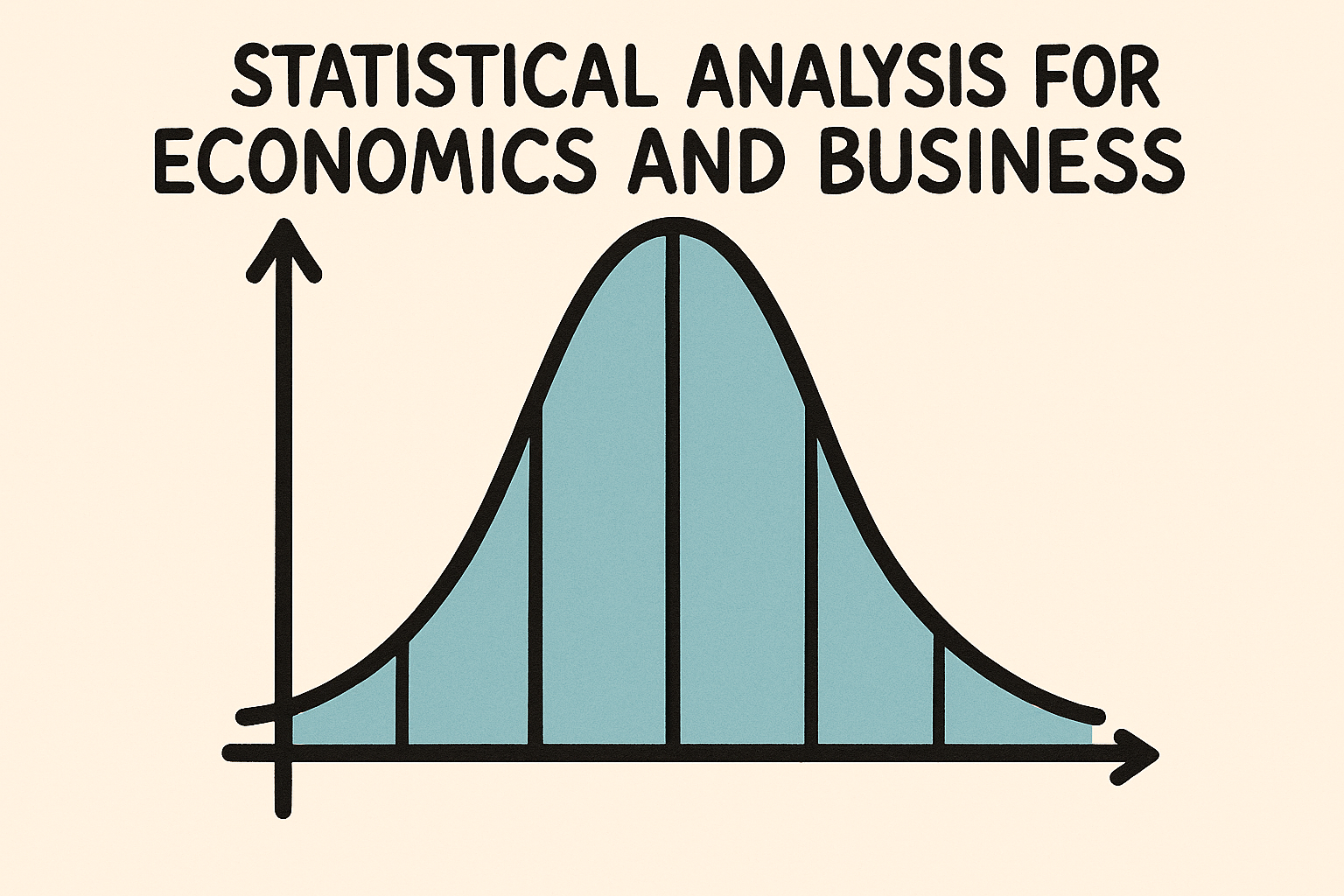

The aim of the course is to introduce students in Management and Business Studies to statistical methods for analysing multivariate data. After completing the course, the student is able to undertake high-quality quantitative research in Management and Business Studies, including International Business, Logistics, Management, Marketing and Strategy.
- Teacher: Niklas Ahlgren
- Teacher: Niclas Meyer

The course is intended as an introduction to advanced econometrics. A broad outline of the topics covered in this course are probability, linear time series models, dependent processes, asymptotic theory for dynamic models, multivariate linear time series models, unit root processes, ARCH and GARCH processes and simulation methods.
The course is intended for master's students in finance and economics with an interest in statistics and econometrics. The course can also be taken by doctoral students.
After completing the course, you will be able to:
derive the asymptotic properties of estimators and test statistics in dynamic regression models and time series models.
explain the functional central limit theorem and apply it to derive the properties of estimators and test statistics in time series models with a unit root.
analyse and use volatility models in empirical research in Finance and Economics.
use simulation methods in econometrics.
Literature:
Davidson, J. (2004), Econometric Theory, Blackwell Publishing.
The course is intended for master's students in finance and economics with an interest in statistics and econometrics. The course can also be taken by doctoral students.
After completing the course, you will be able to:
derive the asymptotic properties of estimators and test statistics in dynamic regression models and time series models.
explain the functional central limit theorem and apply it to derive the properties of estimators and test statistics in time series models with a unit root.
analyse and use volatility models in empirical research in Finance and Economics.
use simulation methods in econometrics.
Literature:
Davidson, J. (2004), Econometric Theory, Blackwell Publishing.
- Teacher: Niklas Ahlgren
- Teacher: Alexander Back